Public Toilets in Korea: What Travelers Need to Know
Finding public toilets in Korea is usually easy once you know where locals look first.
In a city, check in this order: subway station → department store or mall → museum/public facility → large café or restaurant → park facility.
But the detail that actually matters is not just where the restroom is. It is whether the toilet is inside or outside the subway fare gates, whether the café uses a shared building restroom, whether the restroom door has a keypad, and whether the facility is still open.
Table of Contents
Start with the subway — but check the fare gates first
Subway stations are usually the easiest first option, but restroom locations differ by station. Some are inside the paid area; others are outside.
If you see the restroom sign before tapping out, use it then.
If you have already exited, do not automatically tap back in just to investigate. Ask station staff:
“Hwajangsil eodi-eyo?” (화장실 어디예요?) — “Where is the restroom?”
They can tell you whether there is one outside the gates or which exit is closest.
On the street, go for predictable buildings
For a restroom quickly, choose a department store, shopping mall, large supermarket, museum, public building, or major attraction before trying random small shops.
They are easier because the restroom is usually signed and you do not need to negotiate with staff.
Convenience stores are different. A convenience store does not automatically mean there is a customer restroom inside.
The café toilet may not actually be inside the café
In many commercial buildings, the restroom is outside the café itself.
In many Korean commercial buildings, cafés, restaurants, salons, and shops share a restroom somewhere in the building. You may need to:
- Go into the hallway
- Walk up or down one floor
- Use a key from the counter
- Enter a door code
- Use a restroom shared by all tenants on that floor
If you do not see a toilet inside the café, ask before assuming there is none.
Useful question:
“Hwajangsil eodi-eyo?” (화장실 어디예요?)
If the staff answers with a string of numbers, they are probably giving you a keypad code. Save the code before leaving the counter.
Toilet paper: public-restroom policy first, local sign second
This is one area where old Korea travel advice can be misleading.
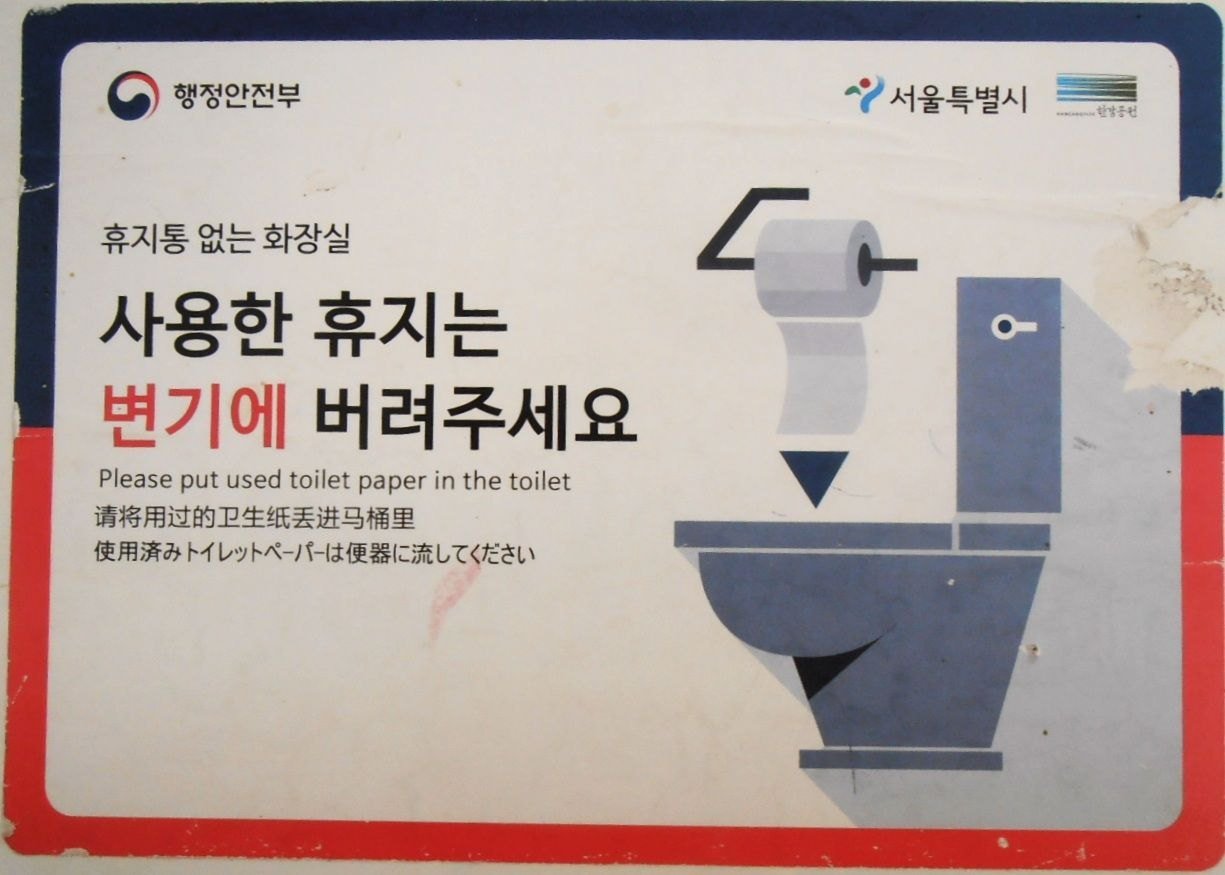
Since 2018, Korea’s public-restroom policy has been to remove ordinary waste bins beside toilets and have used toilet paper flushed down the toilet. Women’s stalls still have separate sanitary-product disposal bins.
So in a normal public restroom, toilet paper goes in the toilet.
An accessible restroom may still have a bin for non-flushable care products.
However, private or older buildings may still post their own instructions because of plumbing conditions. If you see a clear sign telling you what to do, follow the sign in that restroom.
Do not flush wet wipes, sanitary products, paper towels, or other non-toilet-paper items.
How to find public toilets in Korea on your phone
For map searches, type 화장실 into Naver Map or Kakao Map. The Naver Map English guide explains how to search and navigate with Korean place names.
This is particularly useful around:
- Hangang parks
- Hiking areas
- Large markets
- Parks
- Tourist districts with public facilities
Markets and older neighborhoods: do not waste time trying every shop
In a traditional market or older commercial street, individual shops may not have a public restroom.
Instead, look for:
- Market customer-service center
- Public parking building
- Subway station
- District/public facility
- Large supermarket or mall attached to the market
- Signs saying 개방화장실 (publicly accessible restroom)
This is usually faster than asking five tiny businesses one by one.
If accessibility matters, plan with larger facilities
For an accessible restroom, baby-changing facilities, or a place where staff can help, start with subway stations, malls, museums, major attractions, and other public facilities.
Seoul’s official subway accessibility page lists accessible-restroom availability by station.
That is much more useful than arriving and hoping the nearest small café works for you.
Han River: check the park map, not just the nearest café
Hangang parks have restrooms, but the parks are long. The closest one can still be a substantial walk away.
Seoul’s official Hangang guidance links to Smart Seoul Map, where visitors can check restrooms and other park facilities.
Before settling far from a convenience facility for several hours, open the map once and check where the nearest restroom is. This matters more at night, when some indoor facilities may close before the park itself does.
Hiking: use the obvious toilet before you start
At hiking areas, use the restroom near the subway station, bus stop, parking lot, visitor center, trail entrance, or main temple or facility before going deeper into the trail.
A restroom shown farther up the mountain may exist, but it can be seasonal, closed, or simply much farther away than it looks on a flat map.
Carrying a small tissue pack on a long hiking or market day is still useful backup, even though most major public restrooms are well supplied.
A few things that are normal in Korean restrooms
You may see bidet controls, heated seats, baby seats, or an occasional squat toilet in older facilities.
How to flush a Korean toilet
The flush control may be a button on the wall, a lever on the tank, or a clearly marked button on a bidet remote. There is no single layout.
On a bidet remote, look for a toilet or flush icon or the Korean label 물내림. Do not confuse it with 세정 (wash) or 비데 (bidet), which start washing functions.
If the panel is unclear, check the tank and wall before pressing buttons at random. You do not need to use any of the other bidet controls.
In newer buildings, the restroom entrance may also be down a hallway that looks almost like a staff-only area. If the café staff points you there, you are probably going the right way.
If you need a restroom right now
Use this order:
- Look for a subway restroom sign before leaving the station.
- If already outside, head to a mall, department store, museum, or large public building.
- Search 화장실 in Naver Map or Kakao Map.
- In a café or restaurant, ask staff — the toilet may be in the shared hallway.
- Around markets, look for 개방화장실, a public parking building, or the market service center.
That is usually faster than walking into random convenience stores.
Official information
- Ministry of the Interior and Safety — Public-restroom bin policy
- Ministry of the Interior and Safety — Accessible-restroom bin exception
- Seoul Metropolitan Government — Subway Accessibility Facilities
- Seoul Metropolitan Government — Life Platform Hangang
Last verified: September 24, 2026