How to Ride Seoul Night Buses (Owl Bus): Routes, Operating Hours & Fares
Missing the last subway in Seoul does not automatically mean waiting for morning or taking a taxi across the city. Seoul’s late-night Owl Buses, usually called N buses, keep 14 long routes moving between major districts while most of the subway is closed.
The useful part is knowing that they exist. The tricky part is choosing the correct stop and direction at 1 a.m., when two stops with similar names may sit on opposite sides of a wide road. This Seoul night bus guide focuses on that moment: how to check the route, understand the published hours, pay the fare and get off without guessing.
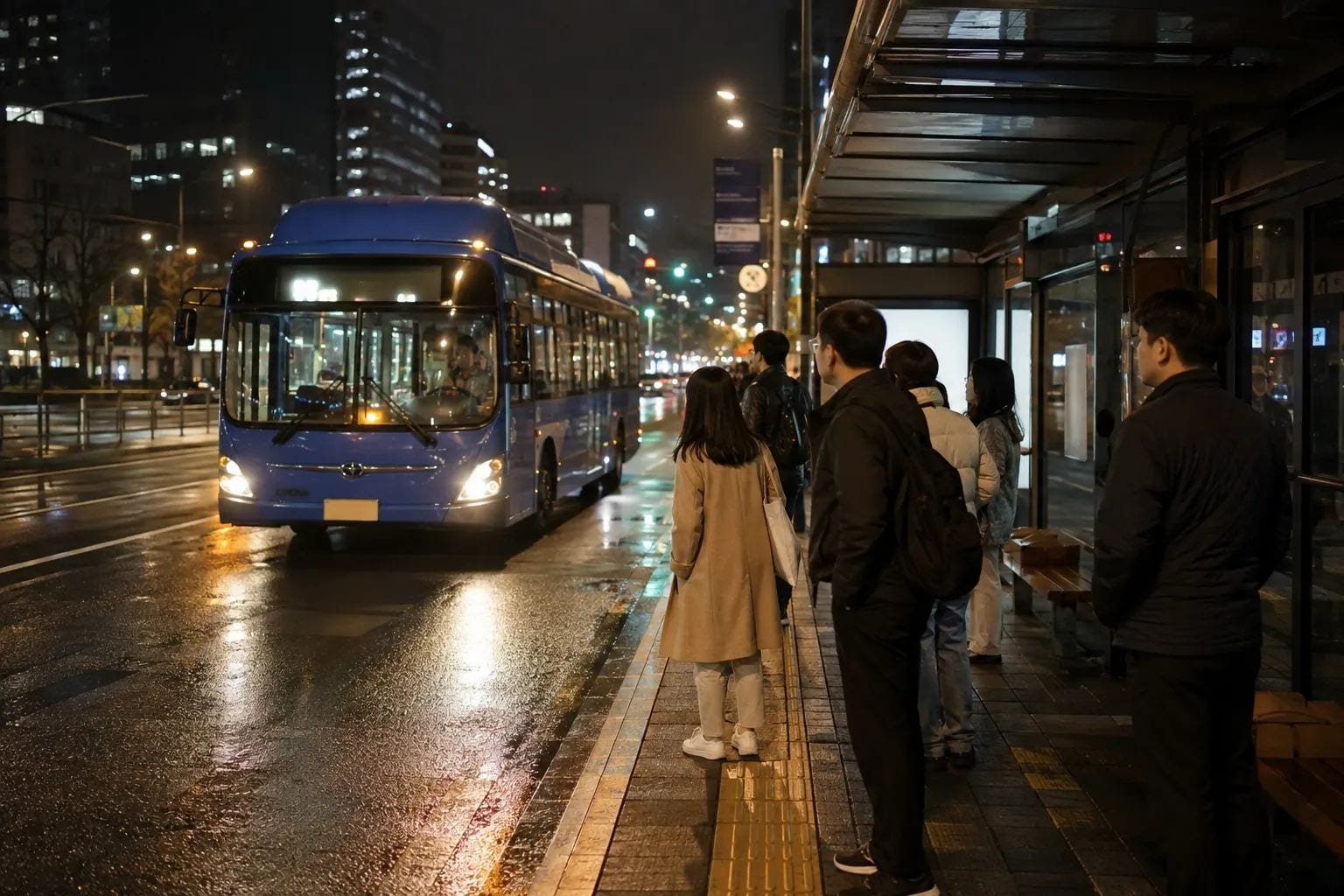
Table of Contents
Seoul Owl Bus at a Glance
| What to know | Current practical answer |
|---|---|
| How to recognize it | Route numbers begin with N, such as N13 or N75 |
| Network | 14 routes and 140 buses in the Seoul city network |
| Overall operating window | Approximately 11 p.m. to 6 a.m.; each route has its own endpoint departure times |
| Adult fare | ₩2,500 by transportation card; Seoul’s fare table also lists ₩2,500 cash |
| Transfer window at night | Within 60 minutes after tapping off, from 9 p.m. to 7 a.m.; other transfer conditions apply |
| Best way to plan | Check the exact stop, direction and live arrival in Naver Map, Kakao Map or Seoul TOPIS |
The network and route details below come from the Seoul Metropolitan Government’s Owl Bus page, updated March 20, 2026. The adult fare and transfer rules are also listed on Seoul’s current English bus information page.
One detail matters immediately: “11 p.m. to 6 a.m.” describes the network’s broad service window. It does not mean every N bus leaves every stop continuously until 6 a.m. The published first and last times are route-terminal departures, not promises that a bus will reach your stop at those exact times.
The 14 Seoul Night Bus Routes
This table is for choosing a likely corridor. It does not replace a live journey search, because a long route can pass through many stops between its two endpoints.
| Route | Endpoints | Published interval | First–last terminal departures |
|---|---|---|---|
| N13 | Sanggye-dong ↔ Jangji-dong | 20–30 min. | 23:30–03:40 |
| N15 | Ui-dong ↔ Sadang Station | 15–30 min. | 23:30–03:30 |
| N16 | Dobongsan ↔ Onsu-dong | 20–30 min. | 23:50–03:45 |
| N26 | Banghwa-dong ↔ Sinnae-dong | 20–25 min. | 00:00–03:25 |
| N30 | Gangil-dong ↔ Seoul Station | 30–35 min. | 23:10–03:50 |
| N31 | Gangil-dong ↔ Jeongneung-dong | 35–40 min. | 23:30–03:50 |
| N37 | Jangji-dong ↔ Jingwan-dong | 25–30 min. | 00:00–03:10 |
| N51 | Siheung-dong ↔ Hagye-dong | 30 min. | 23:40–03:45 |
| N61 | Sinjeong-dong ↔ Sanggye-dong | 10–30 min. | 23:40–04:10 |
| N62 | Sinjeong-dong ↔ Myeonmok-dong | 15–20 min. | 23:40–03:10 |
| N64 | Gaehwa-dong ↔ Yeomgok-dong | 30–35 min. | 23:40–03:15 |
| N72 | Susaek-dong ↔ Sinnae-dong | 30–40 min. | 23:30–03:45 |
| N73 | Gusan-dong ↔ Jangji-dong | 35 min. | 23:30–03:35 |
| N75 | Jingwan-dong ↔ Sillim-dong | 25–30 min. | 23:30–03:50 |
If you remember an older list with N32 or N34, check again before traveling. The city’s March 2026 table lists N31 and N73 in the current 14-route network. This is exactly why a saved blog graphic or an old screenshot should not be your final check.
The endpoints can also be misleading when you are unfamiliar with Seoul. You do not need to be traveling all the way to Jangji-dong to use a route ending there. Think of the terminal name as the direction label, then open the stop list to see whether the bus passes near your actual destination.
Plan the Ride Before the Last Subway Leaves
Save two plans before going out: the normal subway route and the late-night backup. Waiting until the subway doors close adds pressure to a search that already involves unfamiliar stop names.
1. Search your exact destination
Use your hotel’s saved place pin, not only the neighborhood name. A bus may bring you to the right district but still leave a long uphill walk or a wide road to cross.
Naver Map and Kakao Map provide public-transport routes and live bus information, while Seoul TOPIS is the city’s official transport-information service. For Naver Map setup and Korean place-search tips, see Naver Map English guide.
2. Check the stop number and direction
Match all three details before walking over:
- the route number beginning with N;
- the bus stop name or numeric stop ID;
- the direction or terminal shown for that side of the route.
Do not choose a stop merely because the correct N number appears there. The bus traveling the other way may board across the road, around a corner or on a central bus platform.
3. Open the stop list
Look at several stops after boarding, not just the terminal name. This confirms that your chosen bus reaches the correct side of your destination area. Take a screenshot of the route and your stop while you have a stable data connection.
4. Check the live arrival again
Published intervals range from around 10 to 40 minutes depending on the route and time. Traffic and service conditions can change the actual wait. A “last bus” estimate deserves an extra check; arrive early instead of timing your walk to the final minute.
How to Board and Pay
The boarding routine is the same one used on ordinary Seoul city buses.
- Wait where the driver can see passengers at the stop.
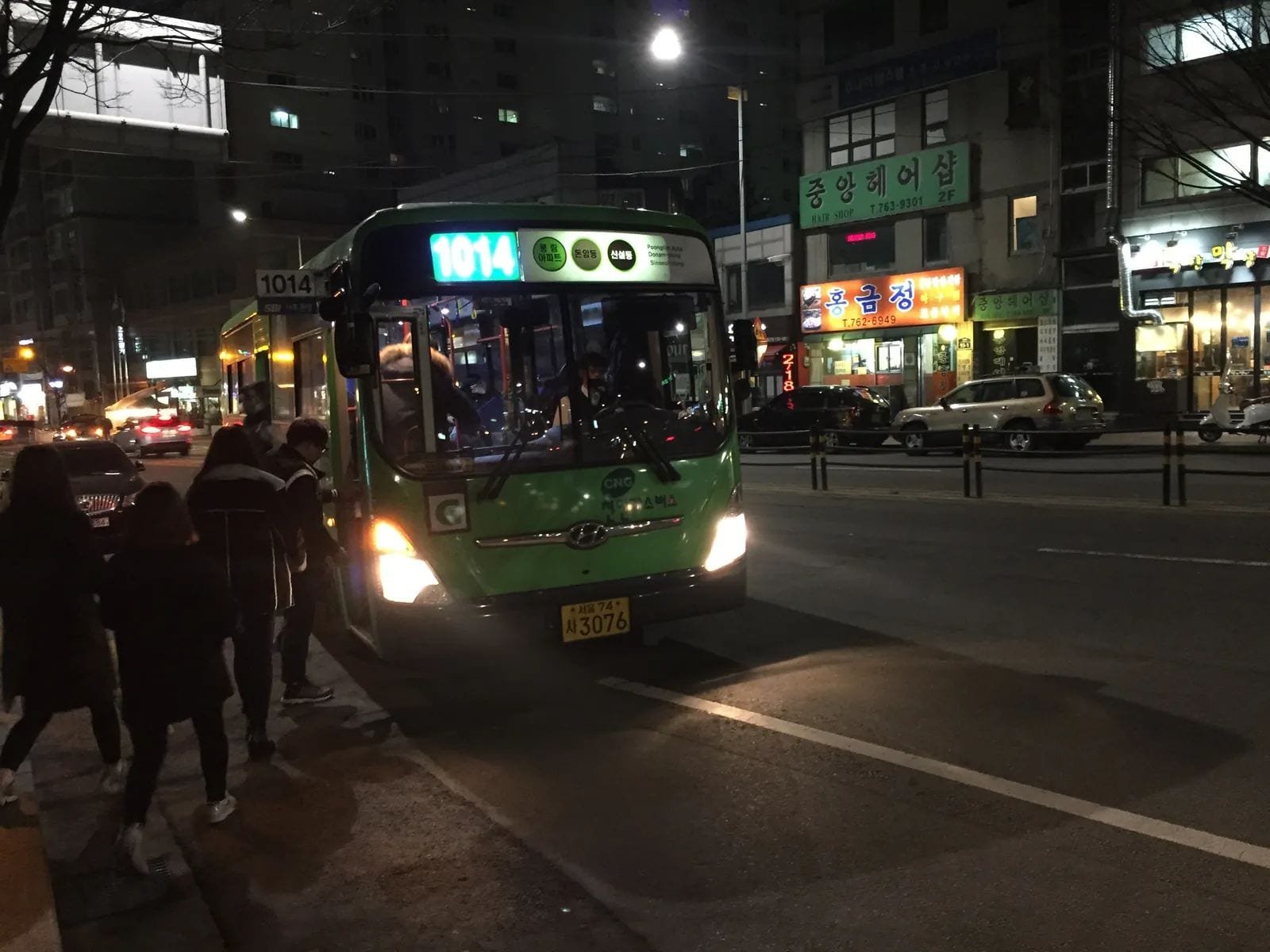
- Confirm the illuminated route number and direction before boarding.
- Enter through the front door.
- Tap your transportation card on the reader beside the driver.
- Follow your progress in the map app and on the onboard announcements or display.
- Press a stop button before your stop.
- Tap the card again at the rear-door reader, then exit through the back door.
Seoul’s English public-transport guide shows the front-door boarding, rear-door exit and card-reader sequence. The second tap is easy to forget when you are tired, but it matters for transfer calculation.
Fare, T-money and Transfers
The current adult Owl Bus fare is ₩2,500. A rechargeable transportation card is the easiest option because it handles the fare and any eligible transfer automatically. The city’s fare table also lists cash at ₩2,500, but relying on exact cash late at night adds one more thing that can go wrong.
Seoul’s transfer window is extended at night: after tapping off, the next eligible boarding must be within 60 minutes between 9 p.m. and 7 a.m. Transfers are accepted up to four times, for a maximum of five boardings, under the city’s rules. Reboarding the same bus route does not receive a transfer discount.
The Climate Card includes Seoul-licensed late-night buses. That can be useful if the card already suits the rest of your trip; it is not a reason by itself to buy a pass for one ride. The current service scope is on the official Seoul Climate Card page.
For a full comparison of T-money, WOWPASS and the Climate Card, read Korea transit card comparison.
If you are traveling as a group, each person carrying a card is the simplest setup. Seoul’s general bus guide describes how a driver can process multiple passengers on one card, but transfer conditions become more restrictive. A Climate Card is one card per person and cannot be used for multi-passenger payment.
Riding at Night Without Losing Track of Your Stop
Keep your phone where you can see the moving location marker, but also listen for the stop announcement. Map apps, onboard displays and your own GPS are useful checks for one another.
Press the red stop button after the previous stop has passed and before the bus reaches yours. If you are unsure, show the driver your destination at boarding or ask another passenger while there is still time to respond. A simple phrase is “이 정류장에 도착하면 알려 주세요” — “Please let me know when we reach this stop.” Show the Korean stop name on your screen with it.
Before getting off, check the walking route from the stop to your accommodation. The final ten minutes matter more at night: use well-lit streets, keep your group together and switch to a taxi if the remaining walk or wait no longer feels comfortable.
The Owl Bus is not an airport night bus. If you are traveling to or from Incheon Airport, search the specific airport-bus, train or taxi option for your flight time rather than assuming an N route will cover the trip.
When the Subway Is Still the Better Choice
An Owl Bus is a backup for a route that works, not automatically the best late-evening option. If the subway is still running and offers a direct ride, it is usually easier to understand and may be faster than a long surface route with traffic lights and many stops.
Check your subway option first, including the last usable connection rather than only the last train from your starting station. A train can still depart while the transfer you need has already ended. See Seoul subway guide.
If no N bus serves your destination without a difficult transfer or long walk, compare a taxi. For two or three travelers heading to the same place, the per-person difference may be smaller than expected. Make the choice from the actual route and pickup point, not from the idea that the bus must always be cheaper or safer.
A Simple Late-Night Checklist
Before leaving the restaurant, concert or bar, check:
- your destination pin and Korean address are saved;
- the N route, stop ID and direction match;
- a live arrival is showing, not only a published schedule;
- your transportation card has enough balance;
- your phone has battery and mobile data;
- you know the walk from the arrival stop;
- you have a taxi backup if the last bus is missed.
This takes a few minutes while you are still indoors. It is a much calmer place to compare two similar stops than the side of an unfamiliar road after midnight.
Frequently Asked Questions
What does the N mean on Seoul buses?
It identifies a late-night route. The current Owl Bus network uses route numbers such as N13, N26 and N75.
Do Seoul Owl Buses run all night?
The network operates broadly from about 11 p.m. to 6 a.m., but each route has its own first and last terminal departures. Check the live arrival for your exact stop and direction.
How much is the Seoul night bus?
The current adult fare is ₩2,500. Youth and child fares are lower under Seoul’s age categories. Check the city fare page if those rates apply to your group.
Can I use T-money on an Owl Bus?
Yes. Tap when boarding and tap again before getting off. An eligible night transfer must occur within the applicable window after the exit tap.
Can I use the Climate Card?
Yes, Seoul’s official coverage includes Seoul-licensed night buses. It excludes categories such as intercity, airport and non-Seoul-licensed buses, so do not treat every late-running bus as covered.
Is the Owl Bus the same as the autonomous night bus?
No. Do not mix an N-route plan with information about a separately named or pilot autonomous service. Search the exact route number you intend to board.
What if no bus arrives in the app?
Recheck the stop ID, direction and operating window. If the expected service is no longer shown, move to a safe indoor or well-lit place and use your backup plan rather than waiting indefinitely.
Sources and Further Reading
- Seoul Metropolitan Government — Current Owl Bus Operations
- Seoul Metropolitan Government — Bus Fares and Transfer Rules
- Seoul Metropolitan Government — Public Transportation and Bus Boarding
- Seoul Metropolitan Government — Climate Card Service Range
- Seoul TOPIS — Real-Time Transport Information
Image credits
- Seoul city bus at night — U2em, CC BY-SA 3.0; resized and converted to JPG.